Medical Schools Jockey for Research Space
By JOSH BARBANEL
Peter Foley for The Wall Street Journal
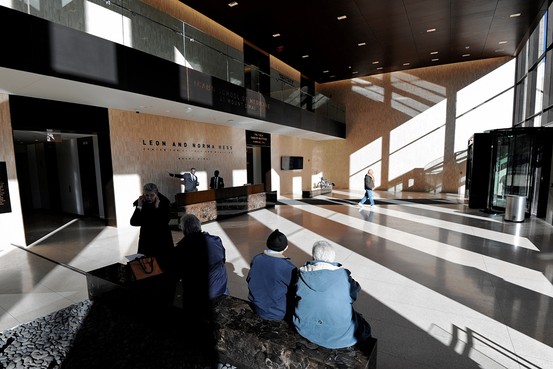
Shafts of light in the
atrium of the new Leon and Norma Hess Center for Science and
Medicine at the Mount Sinai School of Medicine.
When a massive brick-and glass-building officially opens this week at
the Mount Sinai School of Medicine just off Fifth Avenue, it will
herald, doctors there say, a new age of collaboration between
researchers and practitioners that "can change the face of
medicine."
But Mount Sinai isn't alone. A few miles away, Weill Cornell Medical
College is constructing a research building designed to be "at the
vanguard of new medical research and discoveries." And nearby,
Memorial Sloan-Kettering Cancer Center is completing the second phase of
a 700,000-square-foot research complex on East 68th Street.
While other industries have been hobbled by the weak economy, New
York's large medical centers, among the city's largest employers, are
embarked on spending $2 billion on research buildings designed to
attract hundreds of biomedical researchers from around the country.
Peter Foley for The Wall Street Journal
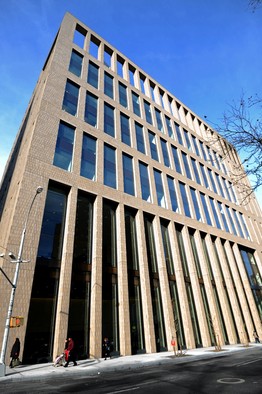
The exterior of the
Hess building and adjacent tower on East 102nd Street just off
Fifth Avenue.
The race to build big new research complexes promises to expand an
important high-tech industry in the city.
But the building spreelargely made possible by low-cost,
tax-exempt financing and large donations from New York's deep bench of
wealthy financiers and businessmenis raising questions of whether
there could be too many institutions chasing too few federal research
dollars to fund operations in the buildings.
The medical schools all have the same plan: recruit researchers who
can work with doctors and patients to translate advances in study of the
human genome and other research into new treatments and curesand
bring in more money from federal research grants and other funding
sources
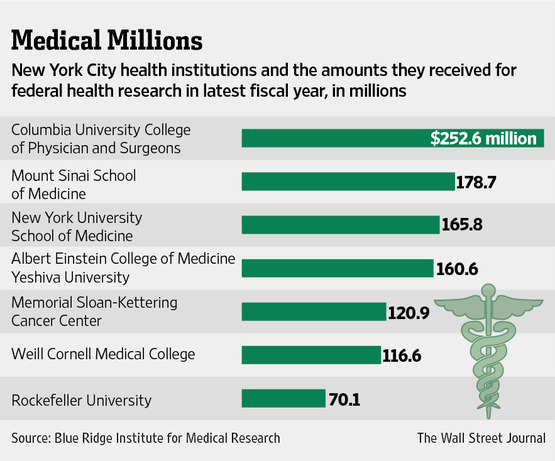
New York City ranks second after Boston in its prowess in winning
grants from the National Institutes of Health, with $1.2 billion in
grants received in the latest federal fiscal year ended in September.
But New York's grants are split among many top-ranked medical centers,
and not one center ranks among the top 10 grant recipients nationally.
As a result many local institutions are looking to expand.
Peter Foley for The Wall Street Journal
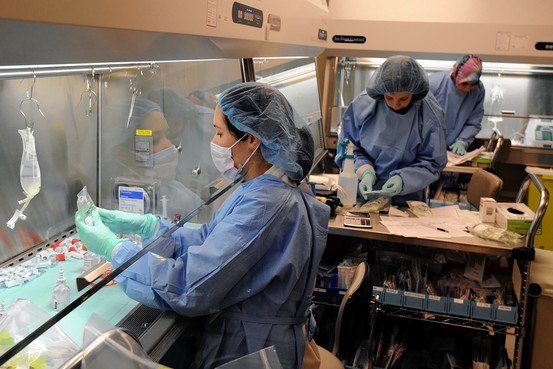
Lab technicians
prepare chemotherapy medications for cancer patients.
Robert Roskoski Jr., a researcher who follows federal health-research
grants, said that NIH funding has been nearly flat in recent years.
"The pot is only so big," he said. "A lot of people are
working hard to get the grants, but they are all fighting for the same
money."
At Mount Sinai, Dean Dennis Charney of the medical school said it
began work on the $640 million projecta combination of research
space, cancer outpatient clinics, faculty medical offices and a 52-story
apartment tower on East 102nd Streetin 2009 because the school had
run out of lab space for new research.
The new building will provide lab benches for the recruitment of 90
new research teams at Mount Sinai, he said. This could generate an extra
$80 million a year in federal grants when the building is fully staffed,
a move that could help Mount Sinai catch Columbia University's medical
school at the city's top recipient of NIH grants.
But Columbia isn't standing still, either. Researchers there will get
about 130,000 square feet of space in a new neuroscience building, the
Jerome L. Greene Science Center, under construction on Columbia's new
Manhattanville Campus in West Harlem. Researchers also will get an
additional 50,000 square feet of space in existing buildings at the
school's Washington Heights campus.
The Weill Cornell Medical College is due to begin moving into a $650
million, 18-story research building at the end of 2013, a building that
will more than double the college's space for research. Dean Laurie
Glimcher said she wanted to bring in "the very brightest
researchers who can go bench to bedside" and wasn't worried about
competition.
"Our goal isn't to compete with each other our goal is to cure
disease," she said. With so much medical progress, she said
"you can't have too many" researchers.
At Mount Sinai, doctors wanted the new research building to reflect
the "gravitas" of the search for disease cures, according to
Ben Ciferri, a vice president at Mount Sinai who oversaw the
construction.
As a result, Skidmore, Owings & Merrill designed a hulking
building with large columns covered with speckled white brick used
elsewhere at the campus. At its center is a 60-foot-high atrium with
balconies that serve as patient waiting rooms. Above that is a winding,
open central staircase designed to foster collaboration among those
working on six floors devoted to research.
The research building was named for Leon Hess, the late oil tycoon,
and his wife, Nora Hess. Two floors are set aside for cancer research
and another two floors for an expanded outpatient cancer-treatment
center. There are also floors for neurological, child health,
cardiovascular and genomic research.
The building is connected to a 52-story tower designed by Pelli
Clarke Pelli, with 229 apartments on the upper floors, about 20% of them
set aside for renters who meet income restrictions. The base of the
tower contains Mount Sinai offices and clinics.
Rents at the apartment tower, listed for as much a $12,000 a month
for a three-bedroom apartment on StreetEasy.com will eventually be used
to support the operations at the medical school, according to Mr.
Ciferri. Tax-exempt financing was issued through two state agencies.
The cancer clinic was moved to the new building first, on the last
weekend in October, just before superstorm Sandy struck the area. That
freed up space at Mount Sinai to take in patients evacuated from other
hospitals.
A version of this article appeared December
13, 2012, on page A22 in the U.S. edition of The Wall Street Journal,
with the headline: Medical Schools Jockey for Research Space. Data
provided by the Blue Ridge Institute for Medical Research.
|