|
To download the pdf file, click on the journal citation |
Comments on the papers by Robert Roskoski Jr. |
| FDA-approved RET protein-tyrosine kinase inhibitors in the management of RET-driven thyroid and lung cancer. Pharmacol. Res. (2026) 229 106237. | A review of RET specific selpercatinib, pralsetinib, and other multikinase inhibitors used in the management of RET-fusion positive and RET-mutant thyroid and lung cancer with a special emphasis on MEN2 syndromes. |
| Bruton protein-tyrosine kinase (BTK) FDA-approved small molecule inhibitors used for the management of neoplastic and inflammatory disorders. Pharmacol. Res. (2026) 227 108187 | A review of BTK blockers used for the management of lymphomas, Waldenstrom macroglobulinemia, urticaria, and chronic immune thromobocytopenia |
| Properties of FDA-approved small molecule protein kinase inhibitors: A 2026 update. Pharmacol. Res (2026) 224 108107. | A review of the properties of the 94 FDA-approved small molecule protein kinase inhibitors, a record 10 of which were approved in 2025. |
| Poly (ADP-ribose) polymerase (PARP) inhibitors approved for the treatment of cancer. Pharmacol. Res (2025) 222 108055. | PARP inhibitors are FDA-approved for the treatment of breast, prostate, ovarian, and pancreatic cancers bearing BRCA1/2 mutations. |
| Vascular endothelial cells and angiogenesis. Pharmacol. Res (2025) 221 107893. | A review of VEGFR1/2/3, angiopoietin-Tie1/2, and ephrin ligands and ephrin receptors, the largest receptor protein-tyrosine kinase family. |
| Orally effective FDA-approved protein kinase targeted covalent inhibitors (TCIs): A 2025 update. Pharmacol. Res (2025) 217 107805. | A review of the properties of 11 orally bioavailable FDA-approved targeted covalent inhibitors |
| Properties of FDA-approved small molecule protein kinase inhibitors: A 2025 update. Pharmacol. Res (2025) 2016 107723. | A review of the properties of the 85 FDA-approved small molecule protein kinase inhibitors with emphasis on deuruxolitinb, ensartinib, lazertinib, tovorafenib, and mirdametinib. |
| Targeted and cytotoxic inhibitors used in the treatment of breast cancer. Pharmacol. Res (2024) 210 107534 | Breast cancers are treated with surgery, radiation therapy, immune checkpoint inhibitors, and small molecule protein kinase and CDK4/6 inhibitors |
| Targeted and cytotoxic inhibitors used in the treatment of lung cancers. Pharmacol. Res. (2024) 209 107465. | Lung cancers are treated with surgery, radiation therapy, immune checkpoint inhibitors, and small molecule protein kinase inhibitors such as osimertinib. |
| Combination immune checkpoint and targeted protein kinase inhibitors for the treatment of renal cell carcinomas. Pharmacol. Res. (2024) 203 107181. | A review of axitinib with pembrolizumab (Keytruda), cabozantinib with nivolumab (Opdivo), ipilimumab (Yervoy) with nivolumab, and lenvatinib with pembrolizumab combination therapies for RCC. |
| Properties of FDA-approved small molecule protein kinase inhibitors: A 2024 update. Pharmacol. Res (2024) 200 107059. Erratum | A review of the properties of the 80 FDA-approved inhibitors with a special emphasis on the newly approved capivasertib, fruquintinib, momelotinib, pirtobrutinib, quizartinib, repotrectinib, and ritlecitinib. |
| Cost in the United States of FDA-approved small molecule protein kinase inhibitors used in the treatment of neoplastic and non-neoplastic diseases. Pharmacol. Res (2024) 199 107036. | The average monthly cost of drugs used in the treatment of neoplastic diseases is $17,900 and $6800 for the treatment of non-neoplastic diseases. These high prices contribute to the financial toxicity of kinase antagonists. |
| Small molecule protein kinase inhibitors approved outside of the United States. Pharmacol. Res. (2023) 194 106847. | A total of 21 drugs are approved by regulatory agencies in China, Japan, South Korea, and Europe that are not approved in the United States by the FDA. |
| Rule of five violations among the FDA-approved small molecule protein kinase inhibitors. Pharmacol. Res. (2023) 191 106774. | Contains Ro5 data on the 74 FDA approved small molecule protein kinase inhibitors including molecular weight, number of hydrogen-bond donors and acceptors, and the atom-based Log of the Partition coefficient. This does not include ritlecitinib which was approved in June 2023. |
| Deucravacitinib is an allosteric TYK2 protein kinase inhibitor FDA-approved for the treatment of psoriasis. Pharmacol. Res. (2023) 189 106642. | Deucravacitinib targets the pseudokinase domain of TYK2 and is a type IV allosteric inhibitor. This paper also describes seven other FDA-approved inhibitors of the JAK family. |
| Futibatinib (Lytgobi) for cholangiocarcinoma. Trends Pharmacol. Sci. (2023) 44 190-191. | A short review describing a targeted covalent inhibitor (TCI) of FGFR1-4. |
| Properties of FDA-approved small molecule protein kinase inhibitors: A 2023 update. Pharmacol. Res. (2023) 106552. | A review of the properties of the 72 FDA-approved inhibitors with a special emphasis on abrocitinib, asciminib, futabatinib, and pacritinib. |
| Trends in NIH funding to Medical Schools in 2011 and 2020. Acad. Med. (2023) 98 67-94. | Departments of Medicine are usually the largest department in universities and schools of medicine and they receive about 30% of total NIH funding for their organizations. |
| Janus kinase (JAK) inhibitors in the treatment of neoplastic and inflammatory disorders. Pharmacol Res. (2022) 183 106362. | This article describes the seven FDA-approved JAK inhibitors targeting human diseases including abrocitinib, baricitinib, fedratinib, pacritinib, ruxolitinib, tofacitinib, and upadacitinib. |
| Targeting BCR-Abl in the treatment of Philadelphia-chromosome positive chronic myelogenous leukemia. Pharmacol Res (2022) 178 106156. | This article describes the prototypic type IV allosteric inhibitor (asciminib) that binds far from the ATP-binding site. The paper also includes a description of the first-generation (imatinib), second-generation (dasatinib, nilotinib, bosutinib) and third-generation (ponatinib) inhibitors of BCR-Abl. Treatment-free remission (TFR) is also considered. |
| A primer on BRIMR: Understanding the rankings of NIH support from the Blue Ridge Institute for Medical Research. Am J Pathol. (2022) 192 392-394 | This paper provides the methodology used for calculating the rankings and it includes suggestions for submitting corrections. |
| Properties of FDA-approved small molecule protein kinase inhibitors: A 2022 update. Pharmacol Res (2022) 175 106037. | This paper was dedicated to the memory of Dr. Phillip G Schmid - a roommate at the University of Chicago (1960), friend, and early scientific collaborator. A review of the properties of the 68 FDA-approved inhibitors. This paper does not include the recently approved asciminib. To see the complete list of approved inhibitors, click here. |
| Blockade of mutant RAS oncogenic signaling with a special emphasis on KRAS. Pharmacol Res (2021) 172 105806. | The development of the FDA-approved sotorasib for the second-line treatment of KRASG12C-mutant non-small cell lung cancer is a milestone in drug discovery: drugging the undrugable. |
| Writing it right for Pharmacological Research. Pharmacol Res (2021) 170, 105733. | Rules of thumb for creating an article for the Pharmacological Research Journal. Many of these rules can be applied to writing scientific articles in general and to preparing research grant proposals. |
| Hydrophobic and polar interactions of FDA-approved small molecule protein kinase inhibitors with their target enzymes. Pharmacol. Res (2021) 169, 105560. | Of the 65 FDA-approved small molecule protein kinase inhibitors (May 2021), X-ray structures of 43 of these with their target enzymes are considered in this review. Fig. 5 on page 8 is best viewed if printed in landscape. |
| Properties of FDA-approved small molecule phosphatidylinositol 3-kinase inhibitors prescribed for the treatment of malignancies. Pharmacol. Res (2021) 168, 105579. | A review of five FDA-approved PI 3-kinase inhibitors: apelisib, copanlisib, duvelisib, idelalisib, umbralisib. |
| Properties of FDA-approved small molecule protein kinase inhibitors: A 2021 update. Pharmacol. Res (2021) 165, 105463. | A review of all 62-FDA approved drugs as of 1 January 2021. In March 2021, the FDA-approved trilaciclib, which was not included in this manuscript. |
| Orally effective FDA-approved protein kinase targeted covalent inhibitors (TCIs). Pharmacol. Res. (2021) 165, 105422. | A review of seven FDA-approved covalent inhibitors: afatinib, dacomitinib, osimertinib, neratinib, acalabrutinib, ibrutinib, and zanubrutinib |
| NIH funding trends to US Medical Schools from 2009 to 2018. PLoSOne (2020) 15:eo233367. | A paper co-authored by Noble P, Ten Eyck P, and Jackson JB of the University of Iowa based upon BRIMR NIH funding data. |
| The role of small molecule Flt3 receptor protein-tyrosine kinase inhibitors in the treatment of Flt3-positive acute myelogenous leukemias. Pharmacol Res. (2020) 155, 104725. | A review of nine drugs in clinical trials or FDA-approved for the treatment of AML. |
| Properties of FDA-approved small molecule protein kinase inhibitors: A 2020 update. Pharmacol Res. (2020) 152, 104609. | A review of all 52 FDA-approved inhibitors as of 16 August 2019. This does not include upadacinib (approved in 2019 for GIST), zanubrutinib (approved in 2019 for the treatment of mantle cell lymphoma) or avapritinib (approved for rheumatoid arthritis in January 2020). For an up to date showing of all FDA-approved small molecule protein kinase inhibitors, click here. |
| The role of fibroblast growth factor receptor (FGFR) protein-tyrosine kinase inhibitors in the treatment of cancers including those of the urinary bladder. Pharmacol. Res. (2020) 151, 104567. | A review of FGFR inhibitors including FDA-approved erdafitinib. |
| Properties of FDA-approved small molecule protein kinase inhibitors. Pharmacol. Res (2019) 144, 19-50. | A review of all 48 FDA-approved inhibitors as of 1 March 2019. |
| Targeting ERK1/2 protein-serine/threonine kinases in human cancers. Pharmacol. Res. (2019) 142, 151-168. | A review of several drugs that are in clinical trials including ulixertinib, MK-8353, and GDC-0994, none of which are FDA-approved. |
| Cyclin-dependent protein serine/threonine kinase inhibitors as anticancer drugs. Pharmacol. Res. (2019) 139, 471-488. | A review of FDA-approved palbociclib, ribociclib, and abemaciclib and several other CDK inhibitors that are in clinical trials. |
| Small molecule inhibitors targeting the EGFR/Erb family of protein-tyrosine kinases in human cancers. Pharmacol. Res (2019) 139, 395-411. | A review of FDA-approved afatinib, osimertinib, dacomatinib, lapatinib, and neratinib and their interaction with EGFR family receptors |
| Targeting oncogenic Raf protein-serine/threonine kinases in human cancers. Pharmacol. Res (2018) 135, 239-258. | The Ras-Raf-MEK-ERK signaling module is the most important oncogenic pathway and BRAF is the most common protein kinase mutant in human cancers. |
| The role of small molecule Kit protein-tyrosine kinase inhibitors in the treatment of neoplastic disorders. Pharmacol Res (2018) 133, 35-52. | Kit mutations occur in a variety of diseases including gastrointestinal stromal tumors, mastocytosis, core-binding factor acute myelogenous leukemia, and seminomas. The interaction of Kit with imatinib, sunitinib, ponatinib, and several other Kit inhibitors is described. |
| The role of small molecule platelet-derived growth factor receptor (PDGFR) inhibitors in the treatment of neoplastic disorders. Pharmacol Res (2018) 129 65-83. | A review of imatinib, sorafenib, sunitinib and other drugs and their interaction with PDGFRα. Formation of a PDGF fusion protein is responsible for dermatofibrosarcoma protuberans (DFSP) and mutations of PDGFRA occur in a small fraction of cases of gastrointestinal stromal tumors. |
| Role of RET protein-tyrosine kinase inhibitors in the treatment of RET-driven thyroid and lung cancers. Pharmacol Res (2018) 128 1-17. | A review of alectinib, cabozantinib, lenvatinib, ponatinib, sorafenib, sunitinib, and vandetanib in the treatment of differentiated papillary and follicular lung cancer and medullary thyroid cancer and RET-driven non-small cell lung cancers. Abdollah Sadeghi-Nejad, who is on the Board of Directors of the Blue Ridge Institute of Medical Research, is a co-author. |
| ROS1 protein-tyrosine kinase inhibitors in the treatment of ROS1 fusion protein-driven non-small cell lung cancers. Pharmocol.Res. (2017) 121, 202-212. | A review of FDA-approved crizotinib along with cabozantinib, ceritinib, entrectinib, and lorlatinib in the treatment of ROS1-positive NSCLCs. |
| Roskoski, R. Jr. (2017) Vascular endothelial growth factor (VEGF) and VEGF receptor inhibitors in the treatment of renal cell carcinomas. Pharmacol. Res. 120, 116-132. | A review of FDA-approved axitinib, cabozantinib, lenvatinib, sorafenib, sunitinib, pazopanib, and bevacizumab in the treatment of RCCs. |
| Roskoski, R. Jr. (2017) Editorial: Guidelines for preparing color figures for everyone including the color blind. Pharmacoll. Res. 119, 217-218. | The primary colors are red, yellow, and blue. |
| Roskoski, R. Jr. (2017) Anaplastic lymphoma kinase (ALK) inhibitors in the treatment of ALK-driven lung cancers. Pharmacol. Res. 117, 343-356. | A review of three FDA-approved drugs (crizotinib, ceritinib, alectinib) used in the treatment of ALK-positive lung cancer. |
| Roskoski, R. Jr. (2017) Allosteric MEK1/2 inhibitors including cobimetinib and trametinib in the treatment of cutaneous melanomas. Pharmacol. Res. 117, 20-31. | A review of MEK1 and MEK 2 and their interactions with type III allosteric inhibitors that bind adjacent to the ATP-binding sites. |
| Roskoski, R. Jr. (2016) Ibrutinib inhibition of Bruton protein-tyrosine kinase in the treatment of B cell neoplasms. Pharmacol. Res. 113, 395-408. | This paper describes BTK and the development of ibrutinib, a covalent antagonist, used in the treatment of mantle cell lymphoma, chronic lymphoblastic leukemia, and Waldenstrom macroglobulinemia. |
| Roskoski, R. Jr. (2016) Janus kinase (JAK) inhibitors in the treatment of inflammatory and neoplastic diseases. Pharmacol. Res. 111, 784-803. | This paper describes the development of first generation inhibitors including the FDA-approved tofacitinib and ruxolitinib. |
| Roskoski, R. Jr. (2016) Cyclin-dependent protein kinase inhibitors including palbociclib as anticancer drugs. Pharmacol. Res. 107, 249-275. | A review of CDKs and the development of palbociclib. |
| Roskoski, R. Jr. (2016) Classification of small molecule protein kinase inhibitors based upon the structures of the drug-enzyme complexes. Pharmacol. Res. 103, 26-48. | This paper depicts all of the known drug-enzyme structures of all FDA-approved protein kinase inhibitors at the time of submission (25 October 2015). Two additional protein kinase inhibitors have been approved subsequently, but X-ray structures for them are not in the public domain. See www.brimr.org/PKI/PKIs.htm for updates. |
| Roskoski, R. Jr. (2015) A historical overview of protein kinases and their targeted small molecule inhibitors. Pharmacol. Res. 100, 1-23. | Beginning with Fritz Lipmann's discovery of protein phosphoserine at the Rockefeller Institute (1932) and Eugene P. Kennedy's discovery of protein kinase activity at the Ben May Laboratory for Cancer Research at the University of Chicago (1954) to the present. This was the top down-loaded article from July through September 2015 and October through December 2015. |
| Roskoski, R. Jr. (2015) Src protein-tyrosine kinase structure, mechanism, and small molecule inhibitors. Pharmacol. Res. 94 9-25. | This paper was dedicated to the memory of Prof. Donald F. Steiner - advisor, mentor, and discoverer of proinsulin. For a retrospective about him, click here. This was the sixth most downloaded paper in Pharmacological Research from April-June 2015. |
| Roskoski, R. Jr. (2014) ErbB/HER protein-tyrosine kinases: Structure and small molecule inhibitors. Pharmacol. Res. 87, 42-59. | This paper considers the structure and mechanism of the EGFR family in detail. It also contains a review of small molecule ErbB1/2/4 inhibitors approved by the FDA or in clinical trials. This was the 22nd most downloaded paper in Pharmacological Research from Jan-Mar 2015. |
| Roskoski, R. Jr. (2014) The ErbB/HER family of protein-tyrosine kinases and cancer. Pharmacol. Res. 79, 34-74. | This paper was dedicated to the memory of Dr. John W. Haycock, a colleague at LSU Health Sciences Center in New Orleans. This was the second most downloaded paper in Pharmacological Research in April-June 2015. |
| Roskoski, R. Jr. (2013) The preclinical profile of crizotinib for the treatment of non-small-cell lung cancer and other neoplastic disorders. Expert Opin Drug Discov. 8, 1165-1179. | Crizotinib |
| Anaplastic lymphoma kinase (ALK): Structure, oncogenic activation, and pharmacological inhibition, Pharmacol. Res. 68 (2013) 68-94. | This is the 12th article from the Blue Ridge Institute for Medical Research. To see the complete list, click here. This article was the 8th most downloaded Pharmacological Research paper from January-March 2013, the 23rd most download paper from April-June 2013, and the 14th most downloaded paper from Pharmacological Research in 2013. |
| ERK1/2 MAP kinases: Structure, function, and regulation, Pharmacol. Res. 66 (2012) 105-143. | This paper was the third most downloaded paper for the year 2012, the most downloaded paper for the year 2013, and the third most downloaded paper for the year 2014. It was the top downloaded paper for April-June 2015 and the second ranked download for July-Sept 2016. |
| MEK1/2 dual-specificity protein kinases: Structure and regulation, Biochem. Biophys. Res. Commun. 417 (2012) 5-10. | This paper is dedicated to the memory of Dr. Jack D. Herbert, a founding member of the Board of Directors of the Blue Ridge Institute for Medical Research |
| RAF protein-serine/threonine kinases: Structure and regulation, Biochem. Biophys. Res. Commun. 399 (2010) 313-317. | This is the ninth article from the Blue Ridge Institute for Medical Research. To see the complete list, click here. |
| VEGF receptor protein-tyrosine kinases: Structure and regulation, Biochem. Biophys. Res. Commun. 375 (2008) 287-291. | Ranked the second most down-loaded paper of Biochemical Biophysical Research Communications from October/2008-March/2009. |
| Sunitinib: a VEGF and PDGF receptor protein kinase and angiogenesis inhibitor, Biochem. Biophys. Res. Commun, 356 (2007) 323-328. | Ranked the third most down-loaded paper of Biochemical Biophysical Research Communications from April-June 2007. |
| Vascular endothelial growth factor (VEGF) signaling in tumor progression, Crit. Rev. Hematol, Oncol. 62 (2007) 179-213. | First journal article accepted from the Blue Ridge Institute for Medical Research; ranked in the top 25 most down-loaded papers of Critical Reviews of Hematology/Oncology from January 2007- June 2008. |
| Biological Oxidation, In: McGraw-Hill Encyclopedia of Science and Technology, 10th edition, 2007, 2, 51-53.. | . |
| Structure and regulation of Kit protein-tyrosine kinase--the stem cell factor receptor, Biochem. Biophys. Res. Commun. 338 (2005) 1307-1315. | Ranked in the top 25 most down-loaded papers of Biochemical Biophysical Research Communications from October 2005-September 2006. |
| Signaling by Kit protein-tyrosine kinase--the stem cell factor receptor, Biochem Biophys Res Commun. 337 (2005) 1-13. | Ranked the 11th most down-loaded paper of Biochemical Biophysical Research Communications from October-December 2005. |
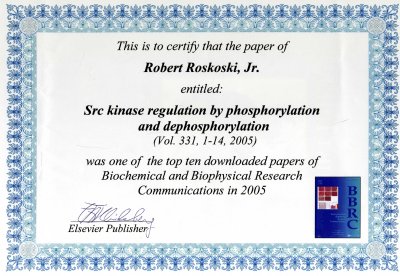
| Src kinase regulation by phosphorylation and dephosphorylation, Biochem. Biophys. Res. Commun. 331 (2005) 1-14. |
|
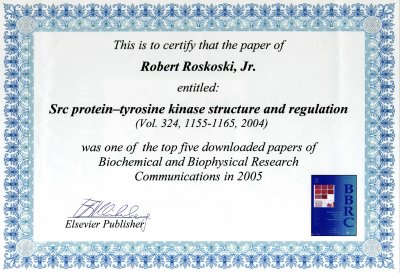
| Src protein-tyrosine kinase structure and regulation, Biochem. Biophys Res. Commun. 324 (2004) 1155-1164. |
|
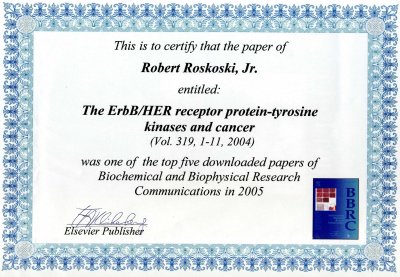
| The ErbB/HER receptor protein-tyrosine kinases and cancer, Biochem. Biophys. Res. Commun. 319 (2004) 1-11. This paper was ranked 13th in Biochemical Biophysical Research Communications downloads for the academic year from October 2009-September 2010. To see the complete list, click here. |
|
| STI-571: an anticancer protein-tyrosine kinase inhibitor, Biochem. Biophys. Res. Commun. 309 (2003) 709-717. | . |
| Protein prenylation-a pivotal post-translational process, Biochem. Biophys. Res. Commun. 303 (2003) 1-7. | . |
|
To see the most cited papers in Pharmacological Research, click here. |
|
To see the most downloaded papers in Pharmacological Research, click here. |
|
. |
|
Today biochemistry is the dominant basic science of medicine in the sense that it outstrips all the others in terms of the number of publications per year. Ulf Lagerkvist |
| . |
Updated 05/15/2026